ChangeOps intelligence for AI + digital releases

Release the change.Ready the whole business.

ChangeFlow connects technical delivery, business impact, operational readiness, adoption, and value—without replacing the tools your teams already use.

Evidence-backedHuman-controlledSystem-connected
Release 2.3
Updated 8 min ago

Refund Resolution Agent

Conditional go

78
Technical94%
Agent quality88%
Security100%
Operational72%
People58%
Measurement80%
02
Blocking issues

Support escalation approval · Manager training threshold

EpicAgentProcessPeople

The problem

A release is never only a technical event.

Engineering knows what changed. Operations knows what broke. Change teams know who needs help. Risk knows what must be controlled. Leadership knows what value was promised.

But no one sees the whole change soon enough.

Fragmented by design

The clues exist. The connection is missing.

Every system tells part of the truth. ChangeFlow resolves those fragments into one release context—without turning itself into another system of record.

01

Delivery says “done”

Epics close and deployments pass while ownership, training, and support work remain unresolved.

Azure DevOps · Jira · GitHub
02

The business catches up

Process, role, communication, and control impacts surface after dates are already committed.

Teams · SharePoint · Entra
03

Value stays unproven

Adoption, incidents, corrections, cost, and outcomes are rarely traced back to release decisions.

ServiceNow · Fabric · Power BI

The solution

One control and learning loop around enterprise change.

ChangeFlow turns scattered records into a shared Change Graph, translates impact into owned readiness work, and makes the release recommendation traceable to evidence.

Follow a change end to end
01
DiscoverDetect material change
02
UnderstandResolve intent + scope
03
ImpactTrace what it affects
04
ReadyCreate owned obligations
05
ReleaseDecide from evidence
06
LearnCompare outcome to intent

Why · What · How

Understand the idea in three moves.

Start with the business problem, see the product model, then inspect the operating method behind every recommendation.

WHY

Change crosses boundaries. Tools do not.

See why technically successful programs still arrive with operational, people, and measurement gaps.

Understand the problem
WHAT

A shared model of change, readiness, and value.

Explore the product modules, core experiences, and the Change Graph that connects them.

Explore the product
HOW

Evidence, policy, intelligence, and human authority.

Follow the eight-stage lifecycle from a new epic to observed adoption and business outcome.

See how it works
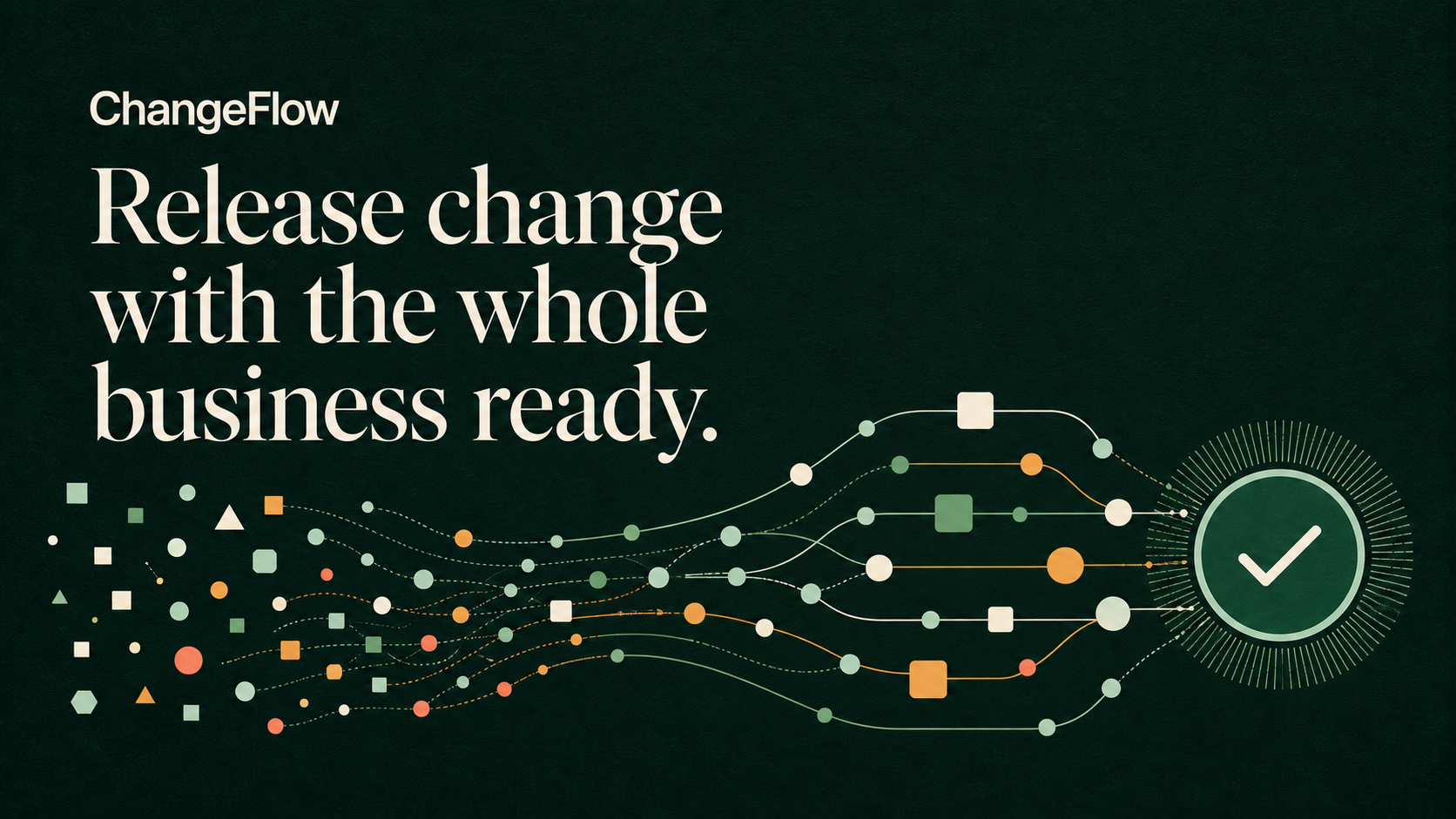
Fragmented signals become an ordered, release-ready decision in ChangeFlow.
From fragmentsThrough evidence-backed relationshipsTo a release-ready decision
Change
2.3
AI agent
Refund API
Store manager
$500 control
25% faster

The differentiator

The Change Graph makes every recommendation explainable.

It connects releases to agents, APIs, data, processes, roles, controls, evidence, adoption, and outcomes. Relationships carry source, confidence, review status, and history.

  • Explicit relationships from systems of record
  • Reviewed proposals extracted from documents
  • Rules that turn context into required work
  • Impact paths a human can inspect
Explore the Change Graph

Built for trust

Intelligence where it helps. Control where it matters.

ChangeFlow uses AI to propose and explain, deterministic policy to evaluate, and accountable people to decide.

01

Connect, don’t replace

Keep source systems authoritative and write work back where teams already operate.

02

Evidence before assertion

Link every material impact, risk, score, and recommendation to its basis.

03

Probabilistic assistance

Use AI for extraction, classification, summarization, and proposed relationships.

04

Deterministic control

Use versioned policy for gates, thresholds, exceptions, and release semantics.

05

Human accountability

Keep control acceptance, exceptions, and release authorization with named people.

06

Learn from outcomes

Compare predictions with adoption, incidents, and business results after release.

Start with one real release

Make readiness visible before production makes gaps expensive.

See the MVP